Showing posts with label Woodpecker. Show all posts

Tuesday, April 06, 2010

Pileated Woodpecker Digging for Ants

Since mid-December, the pileated woodpeckers have been observed at least once a week at the large suet feeder in the Colvin Run Habitat.  This morning, one of the pileated woodpeckers was seen on the trunk of one of the maple trees.
This female (no red mustache) was digging in the remaining mark of a previously removed branch.  No she was not seeking maple sap (as other woodpeckers do), but rather digging ants that have infested this tree. 
From the third photo (click on the photo for a zoomed view), you can get an appreciation of the size of the hole that this woodpecker had dug.  She has her complete bill and perhaps half of her head buried in the hole.
This last photo was taken this afternoon and shows the size of the holes dug.  The site is located about 5 feet off the ground in a line of trees on the Habitat boundary furthest from the woods.  Perhaps this is an indication that these very shy woodpeckers are becoming more comfortable around the Habitat.

Tuesday, March 23, 2010

Tongue of Red-Bellied Woodpecker

Previously, I posted a limited number of photos showing woodpeckers and hummingbird tongues. Today, I took video of the tongue of a male red-bellied woodpecker in action. When the snow was too deep to get needed suet to the feeders, I hung this feeder just outside of the porch windows.  Over the last few weeks, the birds - primarily the woodpeckers - continued to come and eat the suet. The cone shape is a result of the suet sticking to the top of the cage feeder and the reach of the woodpeckers' longer beaks.


When the suet cannot be reached with the beak, the woodpecker tongue - which as you will see is longer than the beak - does a great job at reaching the suet. Above is one frame from the below video in which you can clearly see the curved tongue coming out of the beak and touching the suet. Now take a look at the video below. Enjoy the video.


Where does this woodpecker store his tongue?  The tongue slides to the back of the head, loops upward around the back of the inside of the skull, and then forward around and under the eye.

Thursday, March 18, 2010

Blizzards of 2010: Red-Bellied Woodpecker and Yellow-Bellied Sapsucker

Let's maximize the red in the photo with a male cardinal and a male red-bellied woodpecker.
Here the male red-bellied woodpecker defends the suet feeder from the nearby starling while a female red-bellied woodpecker flies away.
Like the other woodpeckers, the red-bellied woodpecker enjoys the sap on the maples even if he has to dodge the icicles.  
Here the red-bellied woodpecker perches on the oak branches.
And here is the reason the red-bellied woodpecker is called red-bellied.  It is very hard to see this patch of red when he is attached to a tree trunk.  The other woodpecker in the photo is a yellow-bellied sapsucker.  
The yellow-bellied sapsucker shows up every year  in the Colvin Run Habitat during the middle two weeks of February.  Clearly a migratory time, as the yellow-bellied sapsucker usually winters south of Northern Virginia and summers north. In this photo, the yellow-bellied sapsucker enjoys the maple sap (of course) during the morning after.  The second blizzard delivered over 8" of snow to the branch.  For the record, the second storm delivered 30" of snow to the Habitat.  The winter total was over 70" setting a season record at nearby Dulles Airport.

Wednesday, March 17, 2010

Blizzards of 2010: Downy Woodpeckers

The beauty of snow on all of the tree limbs is that birds that are often hard to see - size and color - can be seen easily.  As the snow fell, the downy woodpeckers could be seen landing on the dogwood tree prior to approaching the suet feeders.
During February, all of the woodpeckers - even the downies - spend time on the maple trees to feed on the sap that is running.
All of the woodpeckers keep an alert eye for trouble while on the maples.
In a few months, the leaves will prevent this small woodpecker from being seen at this position on the tree.
This male downy also enjoyed visiting the suet feeder just outside of the back porch window (aka the Colvin Run Habitat observation deck).  This feeder was put up as the suet feeders were not reachable down the hill in the snow.  Within a day, the downies would allow me to walk on the porch while they were at the feeder.

Saturday, February 02, 2008

Birds-in-Flight: Downy Woodpecker

After last Sunday's post, amanda in the city commented that she enjoyed the blue jay and chickadee in flight. So, over the next few posts, I'll show the better photos from my 'birds in flight' collection.
We start with the downy woodpecker. We provide as a reference this first photo, where this male downy is in his normal (photographed) position - attached to the side of a tree.
In the second photo, the downy is in flight - leaving one of the suet feeders (note the suet in his beak). This photo not only shows the white spots on the extended wings, but also shows shape of the wings. Of course, the wings are simply a collection of individual feathers. In this 'birds in flight' collection, I am constantly amazed to see the individual feathers working together to achieve flight.
The third photo captures the downy in, what I call, glide position - wings are slightly extended, but tucked; body and tail are in a tight line to minimize drag as gravity is providing the force. This glide begins typically by the downy simply falling off of the branch, but the destination is always at a lower height than the starting position.
Most times, the downy, and most of birds, start flight by combination of wing extension and downstroke with the legs pushing off. I think this looks like what athletes call a standing broad jump.
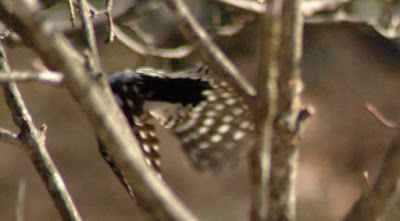
This last photo reminds us that once in flight, the bird needs to continue to keep his wings in montion. This last photo shows the wings at the bottom of the down stroke - where the wing tips end up well below the line of the body. Of course, the stroke began with the wing tips above the body.

This last photo fails to capture the true nature of woodpecker flight, which is undulating. As Wikipedia says, "The repeated cycle of a quick succession of flaps followed by a pause creates an effect comparable to a rollercoaster." These flight characteristics create multiple problems in getting any photo, yet alone a reasonably good one. I'll talk more about photographing birds in flight in a future post.

Friday, September 21, 2007

Northern Flicker Observed

 
As with other birds such as the hummingbirds, we have seen a noticeable decline in the number of northern flicker woodpeckers and red-bellied woodpeckers in the Colvin Run Habitat this summer.
 
So, it was a great thrill to see this flicker appear during a day in July. Of course, the flicker feeds on the ground unlike most other woodpeckers.
 
This flicker was enjoying the many ants that grace the slate pathway.
 

Saturday, July 07, 2007

Great Spotted Woodpecker - Artstre: Flaggspett (Dendrocopus major)

Those of you who read this blog often probably have seen the link Feeding Birds in Norway listed here. The main purpose of that blog is not birds, but Hilde often posts great bird photos from Norway - where the sun always seems to be shining.

I want all of you to take a minute and go to http://knittingplace.blogspot.com/2007_04_01_archive.html - scroll down to Ferieinntrykk/Holiday impressions. You'll finally get to a wonderful photo of a Great Spotted Woodpecker - click on the photo to see an enlarged version.

The Great Spotted Woodpecker looks a lot like the North American Hairy Woodpecker (see photo below) - but the Great Spotted has a brilliant red patch on its back side. Please take a look at this woodpecker in Norway. And, thanks to Hilde!
The hairy woodpecker (a female) is the larger of the two woodpeckers at the suet feeder, the small is a male downy. All of the Habitat hairy and downy woodpeckers are currently drab and gray. I believe that they will soon molt and we'll see their white feathers for the fall.

Wednesday, June 13, 2007

Downy is Down But Not Out

Every few months, one of the birds will fly into the glass windows on the porch overlooking the Habitat. The causes vary - panic as a hawk flies through, pursuing another male which is actually a reflection in the glass, being pushed away from the window-mounted feeder by another bird, youthful flight inexperience, and sometimes, I guess, just not paying attention. Most times when they hit, they drop to the ground and immediately fly away.
Yesterday, after the classic clunk at the windows, I looked to the ground below window and found this downy woodpecker. He (it is a male as you can tell by the red spot on the back of the neck) was lying in the ground cover not moving. Resisting the urge to make physical contact to see if he was okay, I grabbed the camera and got these photos.

For two minutes, he laid (pardon the pun) spread eagle (wings out away from this body) (first photo). Then he regained some consciousness and changed his position (second photo). anther two minutes later, he was up on his feet. At this point, he immediately notice me staring down on him and flew away.
I imagine he had quite a headache for awhile. But then again this was a woodpecker known for beating his head against tree trunks.

Monday, March 26, 2007

Downy Versus Hairy Woodpeckers

We have discussed earlier that the downy woodpeckers and the hairy woodpeckers are differentiated almost solely by size. Their coloring and markings are nearly identical. But, the downy is 6” and the hairy is 9” in length.

In the Colvin Run Habitat, many downy woodpeckers are can be seen in any one hour period. The hairy are far less frequent.

These two pictures of these two woodpeckers on the same suet feeder allow a side by side comparison. Clearly, you can see the size difference. Of course, the smaller downy is a male (red spot on back of neck) and larger hairy is a female. Amazing what you can do with today’s modern photograph software.

Thursday, March 15, 2007

Is Spring Springing?


Today is the Ides of March. The 15th. Halfway between 'March coming in like a lion' and 'leaving like a lamb.' So it was not a surprise that there are blooms on one of the trees. The first photo shows one of the maples 'blooming.' The surprise is that the first tree blooming is a maple (and not a Bradford pear) and that it is the only maple blooming. Guess we have a tree that just could not wait. My memory says that this lone maple is about 2-3 weeks ahead of schedule.
The morning of the Ides started out in the upper 60’s, so it was a great day to get some photos of the white-breasted nuthatch and the downy woodpecker. This female downy is noticeably larger than the other downies.
By dusk, the temperature had fallen by 20 degrees and it was raining. The forecast is for nearly three inches of rain with the last falling as measurable snow tomorrow night. On the Ides, March is a bit scysophrenic about being a lion or a lamb.

Friday, March 02, 2007

Downy Woodpecker - Plays Hide and Seek

With temperatures in the 60s, there was the hope of spring this afternoon in the Colvin Run Habitat. I took the camera and headed out to see which of the birds would come to the feeders with me a few feet away.
This male downy woodpecker first came to the dogwood tree, then to one of the suet feeders. He took hold on the other side of the suet feeder, where I could not see him and he could not see me. Of course, he still understood where I was. So, every ten seconds or so, he would peek around the side of the feeder. He played this game of hide and seek for about a minute, then went his way.
I find that the downy woodpeckers are usually the first to come by when I stand out in the Habitat.

Saturday, February 17, 2007

Yellow-bellied Sapsucker Arrives for First Time

As if not be left out of the 2007 Great Backyard Bird Count, a male Yellow-bellied Sapsucker was observed in the Colvin Run Habitat for the very first time.


Wednesday, February 14, 2007

Woodpeckers in the Snow


Yesterday’s snow and last night’s sleet put a beautiful white highlight across the entire Colvin Run Habitat. A pair of downy woodpeckers (first two photos), a sparrow (third photo), and an American goldfinch (last photo) arrived today to create more peaceful winter photos. Of course, the cardinals posed yesterday.

Red-Bellied Woodpecker Maintains Order at the Feeder

We had snow yesterday, but overnight we received about 4 inches of sleet. The result was a hard crust of ice that prevented the birds from feeding off of the ground.
The feeders, and especially the two window feeders, became busy places. At times (first photo) there were three birds feeding at the window location. Other times, two would feed there and another would hover until there was space enough to land. The starlings came and created total chaos.
The red-bellied woodpecker arrived to feed and to maintain order. She simply pecked the starling against the window. When the starling attempted to take a seed or to get out of corner, the woodpecker just pecked him back into submission. Finally, the starling gave up and flew away.

Tuesday, February 06, 2007

Coming Attractions: Bird Tongues, Birds in Flight, and Strange Poses

Let me use some photos from the past weekend as coming attractions of future posts.
Bird Tongues – Yes bird have tongues. Take a very, very close look at this photo of a downy woodpecker. Look just beyond the very tip of his (he is a male, not the red patch) beak – that small, thin, light covered line is his tongue. I have a series of bird tongues that I promise to dig out and show you.
Birds in Flight – I have shown lots of hawks, egrets, heron, and vultures in flight, but I have a complete series of small songbirds in flight also. Many photos of songbird in flight are taken simply by luck. Nevertheless, they are interesting. In the second photo from this past weekend, the downy woodpecker is leaving his perch in the dogwood tree – an interesting view of simultaneous wing action and leg kick-off. In the third photo, the wren is leaving the suet feeder. From studying the photo, I believe that he starts his wing action prior to letting go with his claws.
Strange Poses – In the last photo, the Cooper’s hawk is striking a strange pose with its long tail in a horizontal, instead of its normal vertical, position. I have an eclectic set of strange pose photos.
So, please return to the Colvin Run Habitat Blog when we talk about tongues, flight, and strange poses.