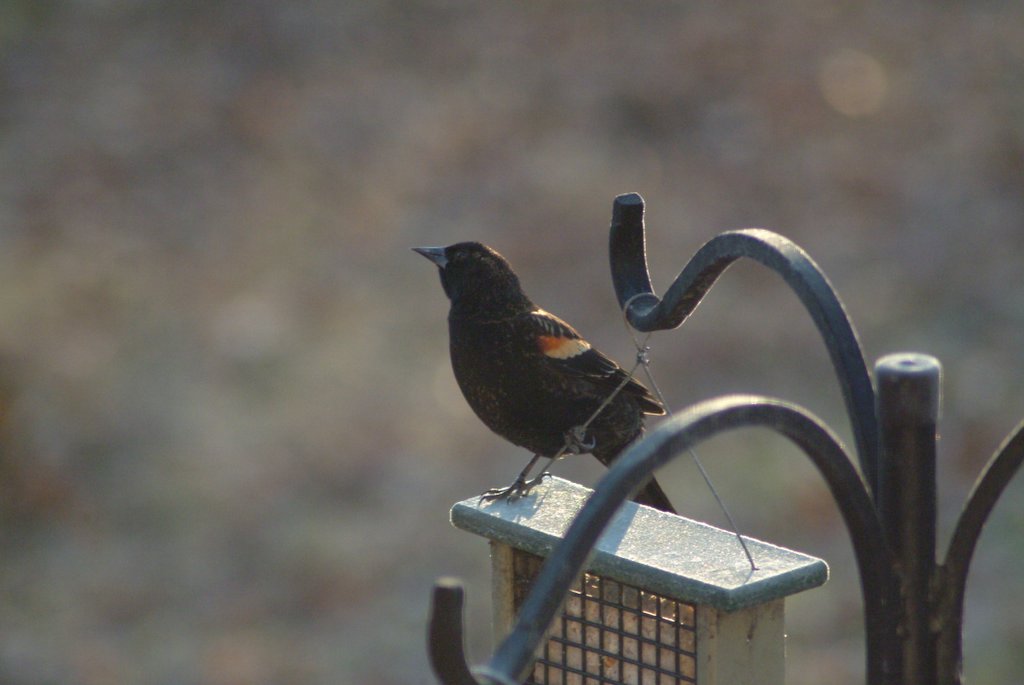
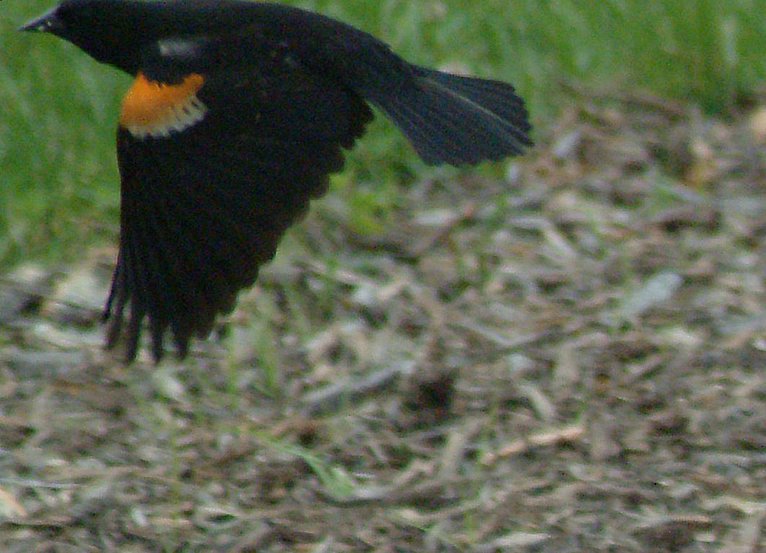
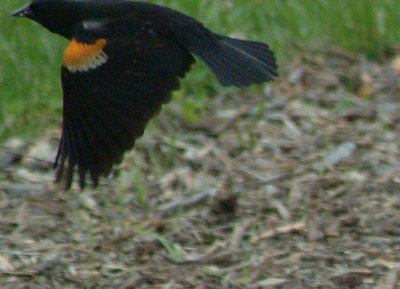
The Cornell Ornithology websites says that the Red-Winged Blackbird is one of the most abundant birds in North America. Unfortunately, the red-winged blackbird has only been observed in the Colvin Run Habitat only twice in the last year – May 20th and today, December 3rd. Too bad, as the male red-winged blackbird has striking marks on its wings – the markings stand brilliant against the rest of its all black body. The female is so drab that it can be mistaken for a large sparrow.
The first photo is today’s red-winged visitor. Note the small amounts of brown speckles in its body – leading me to believe that the guy was hatched this past spring.

The second photo is from the May visitor. Pardon the poor photo quality, but I wanted to show you the red-winged blackbird in flight when you can really see the wing markings. Of course, I always think that this bids marking are orange and not red. I know that this guy has been around for the last week or so as I have heard a new bird call, previously unknown to me. After seeing him today and checking his call on line, it is clear that I have heard him for the last week.
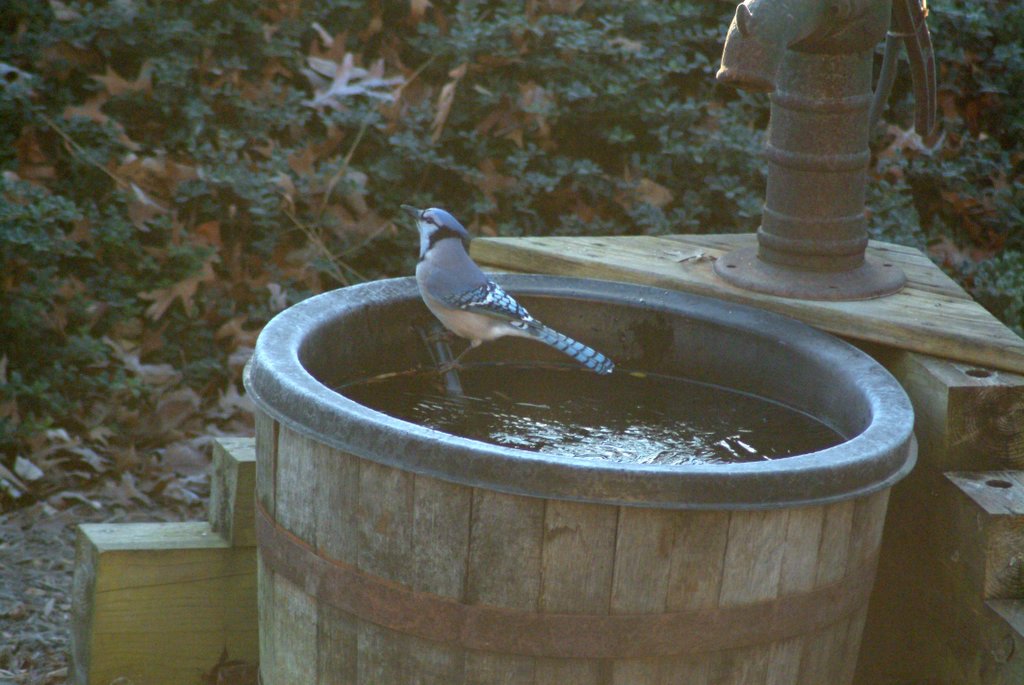
All in all, the fall in the Habitat has been quite mild. As you can see from the third photo, the blue jay was not real pleased that the water tub was frozen over this morning. I guess that it is time to get out the bird bath feeder (talk about decadence).

A few posts ago, I showed you the pair of pileated woodpeckers that were photographed in the Habitat. I saw one of them in the Habitat once in the two days after that post, but not since. This is really not all that uncommon – as I explained previously – the pileated woodpeckers are quite shy. I often hear their hammering on tree trunks – their drumming echo throughout the woods adjacent to the Habitat. This morning, I heard yet another bird call that is not common in the Habitat. As I was unable to see any bird for this very distinct call, I checked the call on-line. Sure enough it was the pileated woodpecker. Click here for a web page that has audio of their call (you’ll need to scroll down the page and click again). The pileated woodpecker’s drumming can be heard at the end of this audio recording.
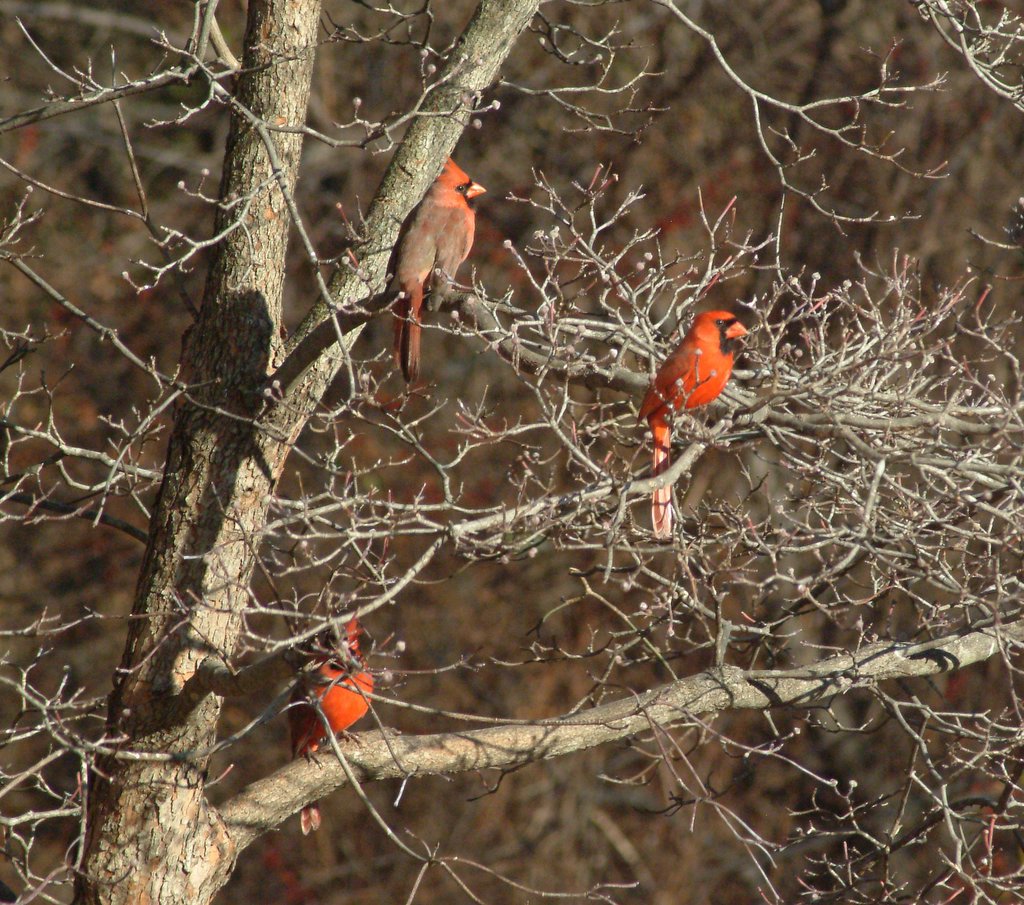
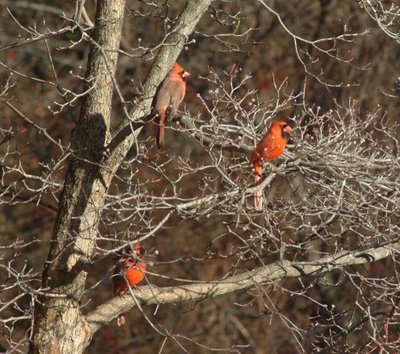
The Habitat is an amazing collection (in number and variety) of birds right now. The just hang out and eat seed and suet – in fact, I am going through see faster now than during the summer. Considerable numbers are roosting in the azaleas and other bushes in the Habitat. The fourth photo is a group of male cardinals enjoying the sun this afternoon.
Quick update: the fox has not been back since Thanksgiving Day and the raccoon has not been seen again since the other night. 
 Yesterday evening, we returned from a short road trip to New York City and Cooperstown (to see the Baseball Hall of Fame) in update New York State.
  The best, and really only, bird photos taken were of this red-winged blackbird located at Glimmering Glass State Park.
 While there are no photos, we also observed a downy woodpecker among the brownstones of 2nd Street in Brooklyn (Park Slope) and a red shouldered hawk in Prospect Park (Brooklyn's equivalent of Manhattan's Central Park). We also observed a pair of wild turkeys in the fields along US 20 in update state New York.