Blizzards of 2010: Carolina Wren Seeks Cover


Take a close look at the upper left corner to see the tail feathers of one of the wrens. Click the photo to zoom in.
 I mentioned that in my walk in the Habitat this week that the male bluebird was defending the nest in the bird box from a house wren. So here are some more photos of the encroaching wren.
 Each time that the bluebird would chase the wren, the wren would leave and return as soon as the bluebird was out of sight.
 Of course, I noted last year that the house wren is known to evict birds from the box.

 Yesterday afternoon, I got home early enough to take some photos in full sunlight. So I took the opportunity to take a walk through the Colvin Run Habitat.
 The result was the observation of nine different types of birds in 30 minutes:
>House Finch
>Carolina Wren
>American Robin
>Common Grackle
>Morning Dove
>Northern Cardinal
>Tufted titmice
>Eastern Bluebird
>Downy Woodpecker
>White-Throated Sparrow
The first photo shows the Northern cardinal (female) that is so common and numerous in the Habitat. The second photo shows the cardinal and a Carolina wren eating at the sunflower seed feeder. Note the seed in the cardinal mouth. In the the third photo, I captured a house finch. Two years ago, the finches were nearly as common as the cardinals, but now I observe only 2-3 finches per month.
 The fourth photo shows a morning dove, another bird whose numbers have decreased in the Habitat in the last year. The presence of a pair this spring is a good sign.
 Number five is a poor quality photo of a common grackle.
 Number six is a photo of one of the tufted titmice, one of the Habitat's birds whose numbers has slowly decreased over the last two years. Currently, the titmice numbers may be increasing.
 And the last photo is an American robin - one of our birds whose numbers has increased during the last two seasons.
In the next three posts, I'll show the bluebirds, sparrows, and woodpeckers that 'played' with me as I walked the Habitat.
Earlier this spring, I posted several photos (see chickadee, then scroll down) of the Carolina Chickadee young in the bird box. I also posted that another bird had taken over the bird box after the chickadee young had departed and I had cleaned out the nest. Even with a distinct nest structure, this bird was unidentified. Additionally, as the nest was built completely to the inside top of the box, I was never able to see a parent on the nest when I opened the box. Yesterday (July 28), I decided that, as I had never in my life seen young still in the nest during the last week of July, it was safe to clean out pile of twigs deposited in the box in preparation of next year. What a surprise I had! When I pulled out the nest, I found three new hatchlings and one unhatched egg.
 All three of the hatchlings were alive, moving, and raised their heads for 2-3 seconds. Each were dry with only wisps of down. Acting quickly, I photographed (what’s another 3 minutes) the new hatchlings, rebuilt the nest in the box, and prayed that a parent would return.
 Within a few minutes of rebuilding the nest (to extract the nest from the box I actually had to pull the nest apart and out in three sections – I rebuilt the nest in reverse order), the mother returned and entered the box (see the fourth photo). She has returned several times today as well.
 I spent several hours on the Web looking for a nest with a similar structure. I found one site that nailed the nest and the bird down as the house wren. Another site also described the house wren as a not so friendly bird that will evict our bird’s eggs and hatchlings, and then build over the existing nest. Basically, the male builds the nest of twigs and then attracts a female that completes the nest lining of feathers, lays and incubates the eggs, then raises the young.
 I went back to photos from about 20 days ago and found these photos of a house wren singing on top of the bird box and perching in a tree. At the time, I did not identify this bird as a house wren.
 Given that the time to lay (one egg per day) and incubate (9 to 16 days) the eggs and that the young that I discovered probably hatched less than a day ago, the reason I never saw a bird on this nest was this all happened in the last 20 days while I was in Texas.
 The new hatchlings will fledge in 15-17 days. I hope to get some additional photos then, as I certainly will not distribute the next again.
 Enjoying the February sunshine, this Carolina wren was uncharacteristically not singing this morning. Rather, he was sounding an alarm call that is a series of screeching-clicks.
 This guy was on the wood pile, most likely searching for insects in all of the nooks and crannies, and rather upset about something. I am guessing that a squirrel was too close, but who knows. Note in the second photo, how far around his head can rotate; he can basically look behind himself.
 Hope he enjoyed the sun, whose time is increasing daily with the coming of spring, but who will not been seen as freezing rains arrives overnight.
I recently posted some thoughts about how small birds stay warm during the winter. One way being they fluff their feathers to trap air that then acts as an insulator. The first photo shows two Carolina wrens. Notice how the wren on the right is fluffed up so that he looks like a round ball.
 The second photo shows an Eastern starling fluffed up almost to being a ball.
 I started the Colvin Run Habitat Blog on September 9, 2006, and began counting visitors one month later when it began clear that some people were actually stopping by to look at the photos. Four months and 101 postings later, 487 unique visitors from 86 cities, in 27 countries, on 6 continents stopped by and read 1230 pages. What a global community that now reads about the Colvin Run Habitat. To all of you readers, many thanks. To all who have posted the Colvin Run Habitat Blog on your blog, a special thanks.
 I simply could not resist plotting the number of visitors over the last four months. To see a map of reader locations worldwide, click on the map below the counter at the bottom of the right hand column. When you get to the next page, click on 'show smaller dots', then click on any continent for more detail. The specific cities are listed below.
 In North America:
>Nunalla, Manitoba, Canada (on the Hudson Bay)
>Tampico, San Luis Potosi, Mexico
>In the United States:
--Phoenix, Arizona
--Tucson, Arizona
--Bakersfield, California
--Los Angeles, California
--Murrieta, California
--Riverside, California
--San Diego, California
--San Francisco, California
--Ft. Collins, Colorado
--Stamford, Connecticut
--Washington, D.C.
--Tampa, Florida
--Atlanta, Georgia
--Marietta, Georgia
--Boise, Idaho
--Chicago, Illinois
--Joliet, Illinois
--Wichita, Kansas
--Baltimore, Maryland
--Boston, Massachusetts
--Lexington, Massachusetts
--Detroit, Michigan
--Minneapolis, Minnesota
--St. Paul, Minnesota
--Springfield, Missouri
--Newark, New Jersey
--Albuquerque, New Mexico
--Binghamton, New York
--Brooklyn, New York
--Elmira, New York
--New York, New York
--Rochester, New York
--Durham, North Carolina
--Fayetteville, North Carolina
--Raleigh, North Carolina
--Columbus, Ohio
--Toledo, Ohio
--Tulsa, Oklahoma
--Portland, Oregon
--Allentown, Pennsylvania
--Philadelphia, Pennsylvania
--Charleston, South Carolina
--Nashville, Tennessee
--Dallas, Texas
--Denton, Texas
--Ft. Worth, Texas
--Houston, Texas
--Fairfax County, Virginia (multiple locations)
--Green Bay, Wisconsin
In South America:
>Bauru, Brazil
>Rio de Janeiro, Brazil
>Buenos Aires, Argentina
>Santiago, Chile
>Cali, Columbia
In Europe:
>Massmechelen, Belgium
>Rijeka, Croatia
>Berwick-upon-Tweed, England
>Bristol, England
>Gloucester, England
>Hastings, England
>Paris, France
>Cologne, Germany
>Frankfort, Germany
>Hamburg, Germany
>Hercegszanto, Hungary (Magyarorszag)
>Bucuresti, Romania
>Murcia, Spain
>Oslo, Norway
>Drammen, Norway
>Bucuresti, Romania
>Murcia, Spain
>Antwerp, The Netherlands
>Maastricht, The Netherlands
In Asia:
>Phnom Phenh, Cambodia
>Changchun, China
>Changsha, China
>Hong Kong, China
>Madras, India
>Jakarta, Indonesia
>Tokyo, Japan
>Manila, Philippines
>Singapore
In Australia:
>Sydney, New South Wales
>Brisbane, Queensland
>Melbourne, Victoria
In Africa:
>Tunis, Tunisia
Let me use some photos from the past weekend as coming attractions of future posts. Bird Tongues – Yes bird have tongues. Take a very, very close look at this photo of a downy woodpecker. Look just beyond the very tip of his (he is a male, not the red patch) beak – that small, thin, light covered line is his tongue. I have a series of bird tongues that I promise to dig out and show you.
 Birds in Flight – I have shown lots of hawks, egrets, heron, and vultures in flight, but I have a complete series of small songbirds in flight also. Many photos of songbird in flight are taken simply by luck. Nevertheless, they are interesting. In the second photo from this past weekend, the downy woodpecker is leaving his perch in the dogwood tree – an interesting view of simultaneous wing action and leg kick-off. In the third photo, the wren is leaving the suet feeder. From studying the photo, I believe that he starts his wing action prior to letting go with his claws.
 Strange Poses – In the last photo, the Cooper’s hawk is striking a strange pose with its long tail in a horizontal, instead of its normal vertical, position. I have an eclectic set of strange pose photos.
 So, please return to the Colvin Run Habitat Blog when we talk about tongues, flight, and strange poses.
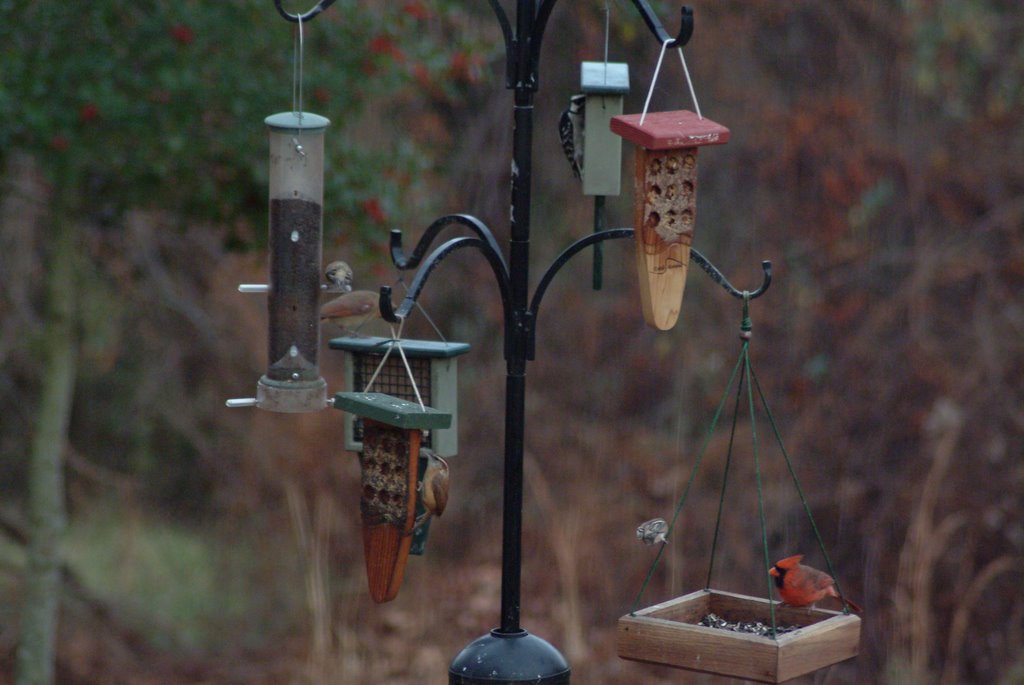 An increasingly popular Christmas card captures the various member of the family. This is an especially great way to show friends and family how the kids have grown over the last year. Well, here is the first of my Christmas cards from the Colvin Run Habitat with many of the family shown.
Actually, this is a great time for backyard birding as the bare trees provides a great view of the birds and there are large numbers and varieties always just hanging around.
In this shot, we have a male and female pair of cardinals, an American goldfinch (in winter olive garb) at the tube feeder, a female downy woodpecker at the suet feeder, and a wren at the peanut butter feeder. Then there is a bird hanging on the strings to the tray feeder - this is the back end view of a white-breasted nuthatch.
Anyway, I thought you would enjoy this holiday buffet of Habitat birds.
On a sadder note, I wrote about the show that the fox put on for all of the human visitors on Thanksgiving Day. I am sad to say that he has not been seen since (about three weeks now). I am even sadder to say that animals (especially deer) are often killed on the 4 lane road near the Habitat and that a fox is one of the recent victims. There is no way to verify that he is one of the summer's Habitat residents, but I am concerned given the close location. I'll report to you as soon as he returns to his throne in the Habitat bush. 
Overcast, rainy, winds gusts to 25 knots, daylight high temperature of barely more than 50 degrees. In short, a raw November day. And yet, there was more action in the Colvin Run Habitat today than on any warm, sunny day.
Things started by surprise. I walked out onto the back porch, only to observe not one, but two Red-trailed Hawks hunting. One of the hawks was momentarily on the ground; that quick he was airborne with something in its talons – from the victim’s size and tail hanging down, I am guessing a chipmunk. The second hawk stayed airborne and rose from about 10 feet to about 30 feet off of the ground. As the second hawk got above the trees, I took the first photograph. As you can see, I only captured its silhouette due to the extremely poor photograph weather.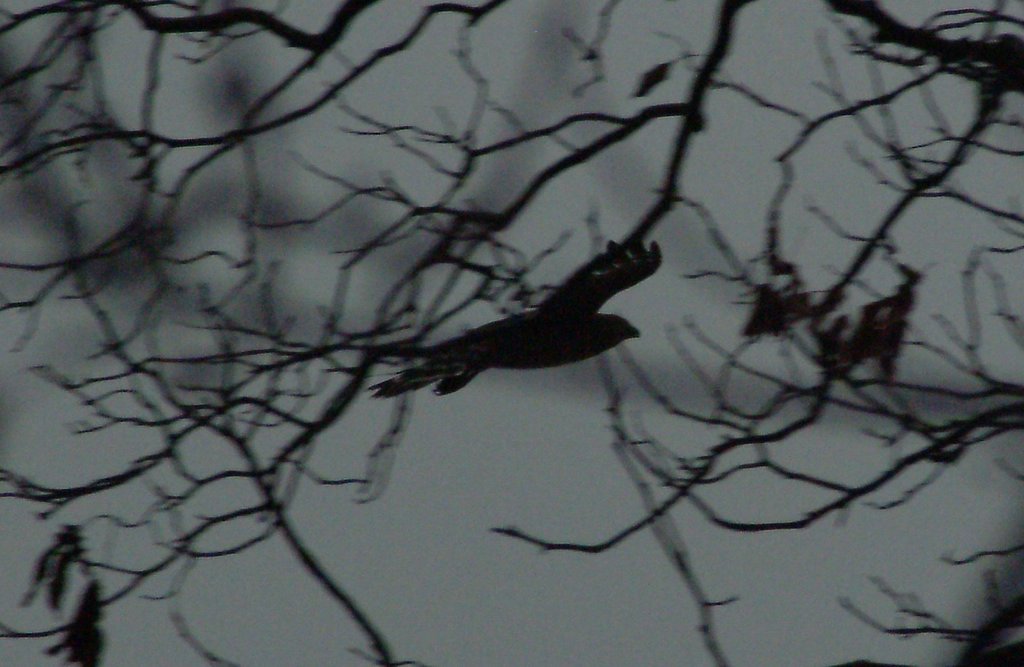
Both hawks were quickly out of sight; I figured that they were gone for the day. But, within the hour they were both back, circling above the Habitat, which is when I got this second photograph. Later, one by one, they returned several times. They were very active just above the tree tops, and also flying through the Habitat below the tree level.
The Habitat sees many different types of birds during the year. However, in the two hour period that begun with the arrival of the red-tailed hawks, 19 different types of birds were observed (listed here from largest to smallest):
1. Red-tailed hawk
2. Turkey vulture
3. Crow
4. Blue jay
5. Red-bellied woodpecker
6. Mockingbird
7. Starling
8. Cardinal
9. Robin
10. Downy woodpecker
11. Nuthatch
12. Titmice
13. Dark-eyed junco
14. House finch
15. Savannah sparrow
16. White-throated sparrow
17. Wren
18. Goldfinch
19. Chickadee
This is an amazing collection. At times I needed to write down what I was seeing before I forgot. I photographed a number of these birds – I’ll share the photos later.
There were clearly some flocks of different types of birds that came through the Habitat during this two-hour period. In the third photo, you can see a flock of starlings. At the same time that the starlings were observed, robins and mockingbirds were also observed – both are unusual in the Habitat at this time of year.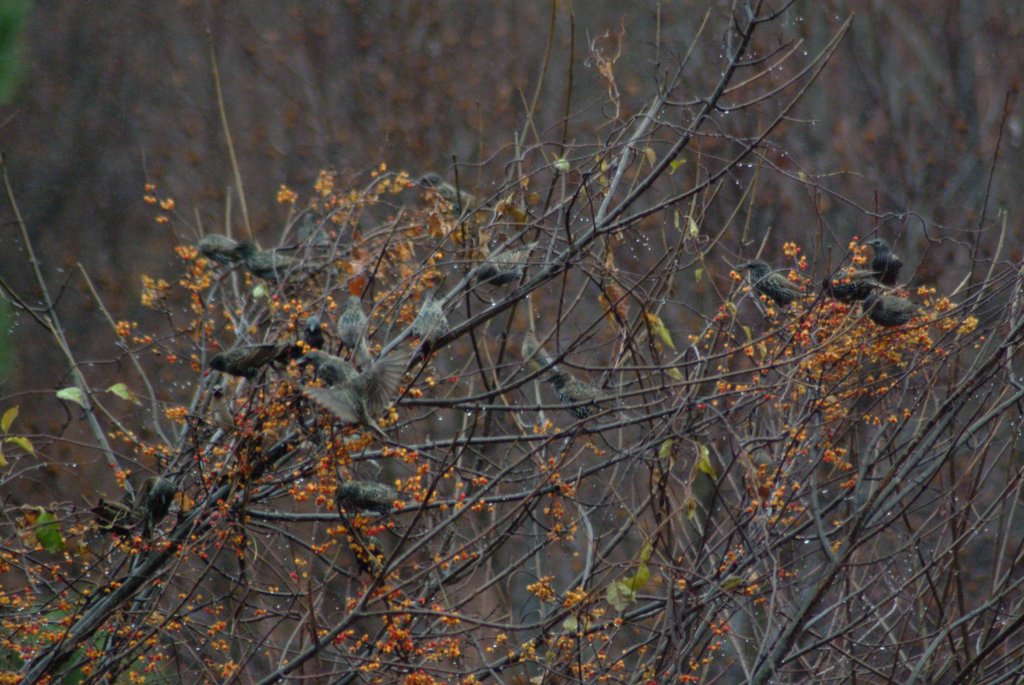
As normal, the ground was full of chipmunks and squirrels. And not to be left out, and as shown in the last photo, the fox showed up late in the afternoon and took his normal observation seat in the brush. He watched the squirrels a bit, looked around a lot, but within 30 minutes he decided to leave; I can only assume he was looking for a place out of the rain.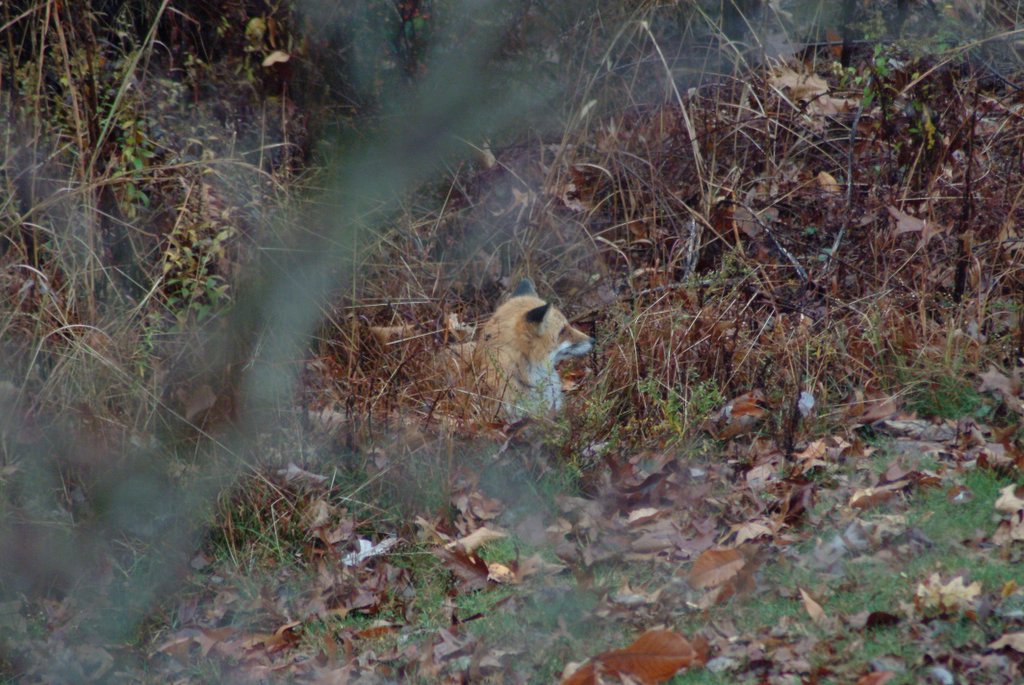
What a truly amazing day!
 In my opinion, the best voice in the Habitat is that of the Carolina Wren. This evening, one of the wrens decided to perch on the sundial and sing and sing and sing. In the first photo, you can ‘see’ the singing – the open beak. The wren’s throat will visibly vibrate as he sings. Back in June, one of the wrens perched on the handrail to the porch steps and serenaded my daughter and me for about 30 minutes. I am sorry that I cannot point you to an audio link where you can hear a wren. It is rare that you cannot hear one of the wrens during any one hour period in the Habitat.
Every once in a while, a wren will pose for me as in this second photo. Similar in size and coloring to the sparrow, I know that I am looking at a wren by the upright cocked tail and the bold white eye stripe. I have to confess that the first time I identified a wren in the Habitat was by looking at a photo and realizing that what I had in the photo was not a sparrow. Most of the time, the wrens are on the ground poking through the mulch or under the shrubs for inserts, as in the third photo. They are very inquisitive birds interested in exploring any nook or cranny. Last May, I was on the porch photographing bird visitors with one of the windows open (better than photographing through the glass). A few minutes after stepping back into the house, I heard from the kitchen noise and returned to a wren inside the porch. He was quite upset at not being able to find his way out. Silly me, instead of picking up the camera, I opened more windows. The wren quickly found a way out. Although they are supposed to be attracted by suet (and really only showed up in the Habitat after I added suet to the feeders), I have never seen a wren at the suet feeder. Most of the time, they pick up sunflower seeds that fall on the ground, and rarely at the sunflower feeder.


This work is licensed under a Creative Commons Attribution-NonCommercial 3.0 License.