Blizzards of 2010: American Robins - Annual Migration

With snow on the ground, the robins were a reminder of a coming spring.

In the week leading up to Christmas, the Colvin Run Habitat saw two snow storms - the first storm delivered 20 inches, the second storm provided another inch of snow. On three occasions - during and after the storms - a flock of American Robins visited the Habitat.


 Yesterday afternoon, I got home early enough to take some photos in full sunlight. So I took the opportunity to take a walk through the Colvin Run Habitat.
 The result was the observation of nine different types of birds in 30 minutes:
>House Finch
>Carolina Wren
>American Robin
>Common Grackle
>Morning Dove
>Northern Cardinal
>Tufted titmice
>Eastern Bluebird
>Downy Woodpecker
>White-Throated Sparrow
The first photo shows the Northern cardinal (female) that is so common and numerous in the Habitat. The second photo shows the cardinal and a Carolina wren eating at the sunflower seed feeder. Note the seed in the cardinal mouth. In the the third photo, I captured a house finch. Two years ago, the finches were nearly as common as the cardinals, but now I observe only 2-3 finches per month.
 The fourth photo shows a morning dove, another bird whose numbers have decreased in the Habitat in the last year. The presence of a pair this spring is a good sign.
 Number five is a poor quality photo of a common grackle.
 Number six is a photo of one of the tufted titmice, one of the Habitat's birds whose numbers has slowly decreased over the last two years. Currently, the titmice numbers may be increasing.
 And the last photo is an American robin - one of our birds whose numbers has increased during the last two seasons.
In the next three posts, I'll show the bluebirds, sparrows, and woodpeckers that 'played' with me as I walked the Habitat.
 Last Sunday at about 3 in the afternoon as I was completing my work for the Great Backyard Bird Count, I noticed a single robin perched in the oak tree among a number of male and female cardinals.
 Then, another robin appeared in the dogwood and still another appeared in the Bradford pear tree. Within a minute, there were two dozen robins in the Habitat. Clearly, a migrating flock of robins had picked the Habitat as a stop over on their way north.
 They quickly found and enjoyed the water available in the tub and the flower pots. The robins mingled with the other birds and were still in the Habitat when the sun went down. I did not see them the next morning. I have not seen them since. In this 2 hour period, I saw more robins in the Habitat than will be observed throughout the spring and summer months.
 Take a close look at this last photo. Notice a bird other than a robin? Who is this previously unobserved-in-the-Habitat visitor? Stay tuned. We'll talk about this fellow in our next posting.

First Flight While we have many, many birds walking and spending time on the ground in the Colvin Run Habitat, it is rare for them to lay on their bellies and have their wings extended. That behavior is a good indicator that we have a young bird taking its first flight, when it basically jumps out of the nest and glides to a nearby branch or to the ground.
 Although not positive, I believe that this first bird is an Gray Catbird, which is a rarely seen resident of the Habitat. This young bird spent about a minute on the mulch then got enough strength to fly (third photo) into the nearby dogwood tree.

Robin Chick Leaving Nest


Here in the Colvin Run Habitat we sometimes forget the our most common birds are not resident in other parts of the world. So I was somewhat surprised last fall when I posted photos of the American Robin - very, very common in the eastern U.S. - and a chap from Australia commented that he had never seen a robin. So as I thought about Australia being in winter as we in the northern hemisphere were in summer, I figured I would post some robin photos. This robin is doing what the robins do best - dig worms from the ground. So to feed the robins, I only have to water the lawn - they love to dig in the soft, wet ground. Great fun - unless you are a worm lower on the food chain.

 In what could be the first preview of the upcoming spring, two birds that do not typically winter in the Colvin Run Habitat appeared in the last two days. First, an American Robin appeared and immediately visited the bird bath.
 Unfortunately, the heater was out of the water, so the robin found only ice.
 Second, a pair of Eastern Bluebirds appeared in the maple trees. The bluebirds did not visit the feeders. Blue birds have not been observed in the Habitat in the last five years. Their early arrival is a clear sign that I need to but out the bluebird house that I received as a Christmas present from my daughter and son-in-law.

Overcast, rainy, winds gusts to 25 knots, daylight high temperature of barely more than 50 degrees. In short, a raw November day. And yet, there was more action in the Colvin Run Habitat today than on any warm, sunny day.
Things started by surprise. I walked out onto the back porch, only to observe not one, but two Red-trailed Hawks hunting. One of the hawks was momentarily on the ground; that quick he was airborne with something in its talons – from the victim’s size and tail hanging down, I am guessing a chipmunk. The second hawk stayed airborne and rose from about 10 feet to about 30 feet off of the ground. As the second hawk got above the trees, I took the first photograph. As you can see, I only captured its silhouette due to the extremely poor photograph weather.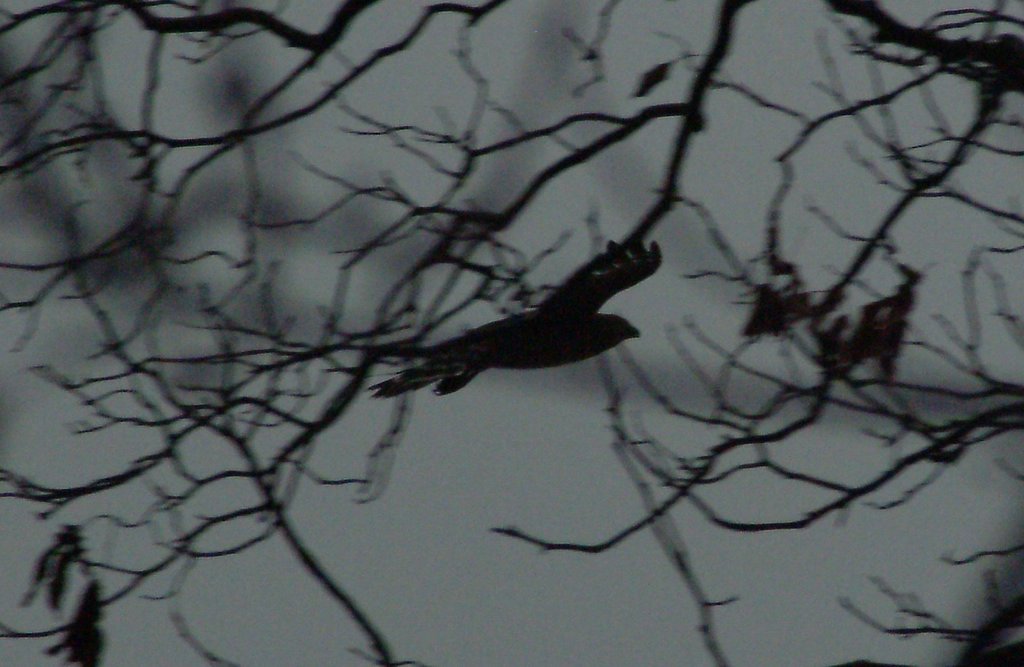
Both hawks were quickly out of sight; I figured that they were gone for the day. But, within the hour they were both back, circling above the Habitat, which is when I got this second photograph. Later, one by one, they returned several times. They were very active just above the tree tops, and also flying through the Habitat below the tree level.
The Habitat sees many different types of birds during the year. However, in the two hour period that begun with the arrival of the red-tailed hawks, 19 different types of birds were observed (listed here from largest to smallest):
1. Red-tailed hawk
2. Turkey vulture
3. Crow
4. Blue jay
5. Red-bellied woodpecker
6. Mockingbird
7. Starling
8. Cardinal
9. Robin
10. Downy woodpecker
11. Nuthatch
12. Titmice
13. Dark-eyed junco
14. House finch
15. Savannah sparrow
16. White-throated sparrow
17. Wren
18. Goldfinch
19. Chickadee
This is an amazing collection. At times I needed to write down what I was seeing before I forgot. I photographed a number of these birds – I’ll share the photos later.
There were clearly some flocks of different types of birds that came through the Habitat during this two-hour period. In the third photo, you can see a flock of starlings. At the same time that the starlings were observed, robins and mockingbirds were also observed – both are unusual in the Habitat at this time of year.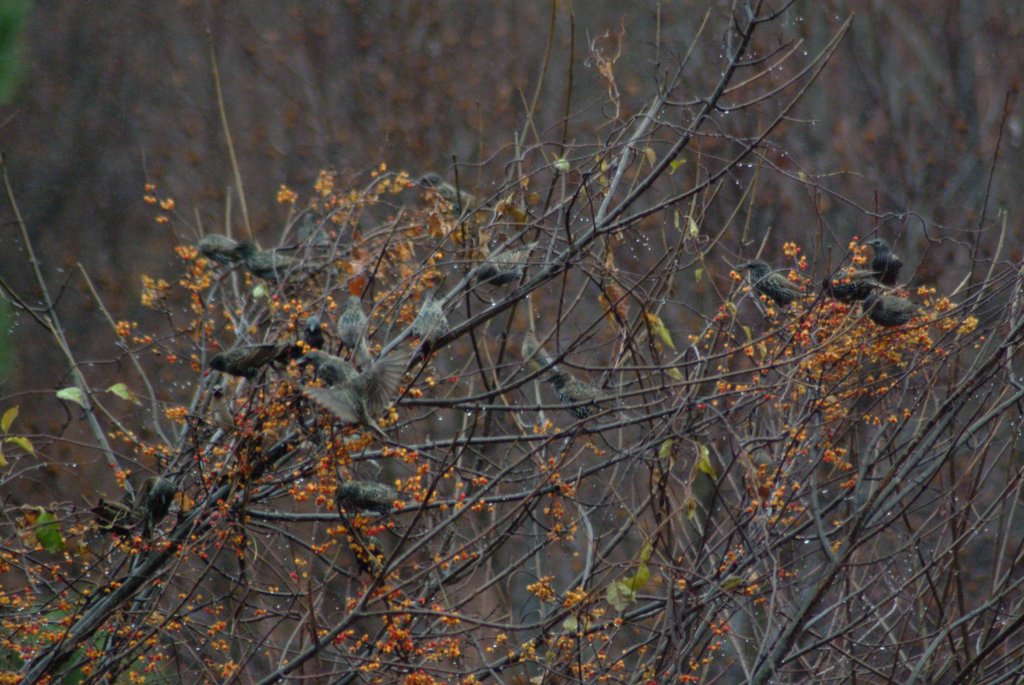
As normal, the ground was full of chipmunks and squirrels. And not to be left out, and as shown in the last photo, the fox showed up late in the afternoon and took his normal observation seat in the brush. He watched the squirrels a bit, looked around a lot, but within 30 minutes he decided to leave; I can only assume he was looking for a place out of the rain.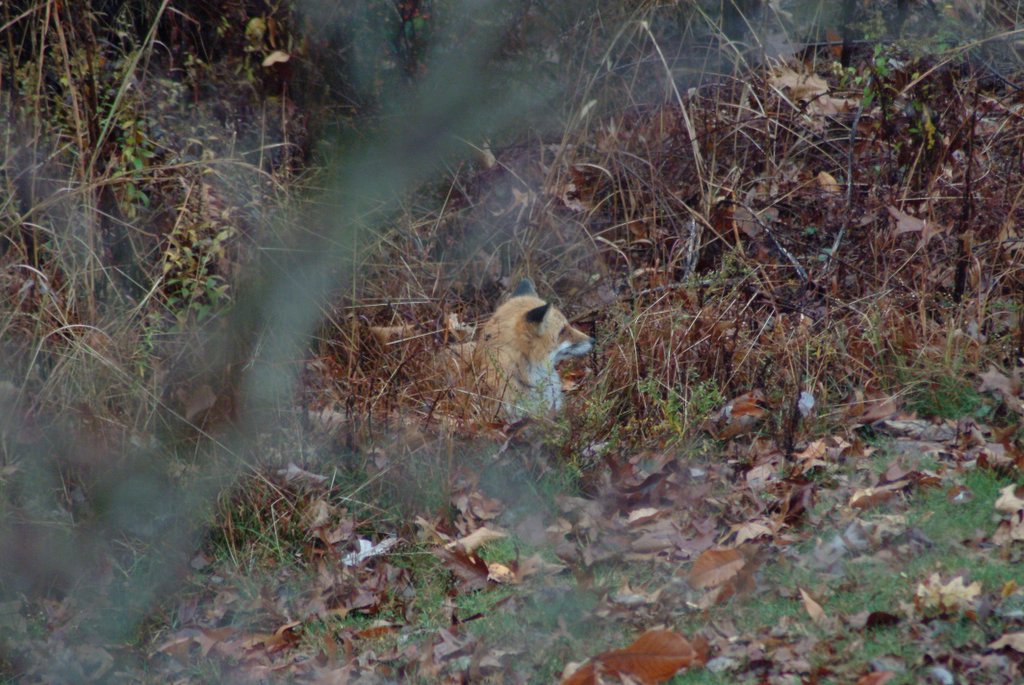
What a truly amazing day! 
 American Robins are numerous in the Habitat, but usually from late-March through August. So, I was quite surprised to see a half dozen robins today. Equally unusual was that they were observed in the trees (first two photos), whereas they are mostly found hunting earthworms on the ground. While migrating robins sometimes go no further south than the mid-Atlantic area, they are rare winter visitors to the Habitat.

Another Habitat visitor that is almost always found on the ground is the Northern Flicker, the only North American woodpecker one that you will see on the ground. Unusual to see one in the Habitat trees (third photo). Flickers are frequent Habitat visitors during the spring. This flicker is the first one seen since about June.
The other unusual sighting today was the hawk. And, as before I was on the porch and the camera was upstairs, so I have no photos. Here is what was unusual - this red-tailed hawk was on the ground, specifically at the base of one of the dogwood trees. Not too unusual to find the hawk on the ground. However, he was eye to eye with a squirrel coming down the trunk of the dogwood. The hawk clearly was not enjoying the position of looking up at what otherwise might have been lunch. The squirrel held is ground (or his trunk) and the hawk finally flew away. And, as mentioned earlier in the week, the fox is back (last photo). This morning, he made a run at the birdfeeder - I am never too sure what he is hunting when he makes such runs - equally likely he is after a squirrel or a bird. This time, he caught no breakfast. He reappeared about 15 minutes later and took up his normal observation seat in the bush at the edge of the lawn. He stayed for about an hour - just taking in the sights.


This work is licensed under a Creative Commons Attribution-NonCommercial 3.0 License.