Northern Flicker Observed


Here is a general update on happenings around the Colvin Run Habitat:
>The ill or injured red-tailed fox has not been observed this week. >Beginning in mid-May, chipmunks began being observed. First on a one by one basis. Now as you can see from the photo, they show up several at a time and are active all day.
 >Sadly, one of the chipmunks drown in the water tub that the birds, chipmunks, and squirrels drink from.
 >For the first time in at least a month, a hawk was observed hunting in the Habitat. Per the standard practice of the Cooper's Hawk, this hawk was seen dropping from one of the border trees down and past the sunflower seed feeder, and then through the dense oak and Bradford pear trees. This hawk was crow-sized, dark brown, tail dark with darker stripes. Most likely given the size, color, and fly-over of the feeder and through the trees, I believe it was a Cooper's Hawk. Sorry no photos as I observed this hawk while looking out the bathroom window while shaving.
>Bird parents are bringing their young to the feeders. Again sorry that I have no good photos. While the young are identified sometimes by coloring and perhaps smaller size, my identification is by behavior. First, the young are only too eager to take food from the parent - even if it is feeder seed. Second, the young have a real tough time landing on the feeders, especially the feeder mounted on the window. The young flutter around the feeder and sometimes stumble into the window or land on the storm windows. Clearly, the young do not yet have complete flight control.
>Although the hummingbirds were observed in May, the hummers have been noticeably absent during the last few weeks.
>Also, the flicker woodpecker is seen maybe once a month. Last year this time, the flicker was a common visitor.
>The red-bellied woodpecker is observed every three weeks.
>The box turtle was observed early one morning in the grass on a path similar to last year.
>In an unbelievably rare event, I opened the garage door one morning to see a pileated woodpecker at the foot of a tree about 20 feet away. Amazingly, this normally very shy woodpecker continued to feed on the driveway tree (insects most likely). Then he flew away, but was heard for the next few minutes giving his unique call from the adjacent woods.
 Various woodpeckers, such as the Downy and Red-Bellied Woodpeckers in the first photo, love to visit the Colvin Run Habitat feeders. While they spend most of their time at the suet feeders, they also eat sunflower seeds, but really have taken to the suet-covered peanuts – like the Red-Bellied Woodpecker in the second photo.
 Of course, the woodpeckers also feed a variety of insects typically found below the bark of trees. Once the woodpeckers find such insects they will come back again, eventually creating a hole in the tree.

 A tree on the side of the house has a large section that is dead. I let the dead section alone since the woodpeckers enjoy drilling in it. As you can see, the holes get large enough that the woodpeckers will actually nest in the holes. The holes in these photos are not large enough for any of the Habitat woodpeckers to nest in, but I am hoping that they continue their woodpecker excavation.
You can find previous woodpecker posts at:
>Downy woodpecker
>Hairy woodpecker
>Pileated woodpecker
>Northern Flicker woodpecker
>Red-bellied woodpecker
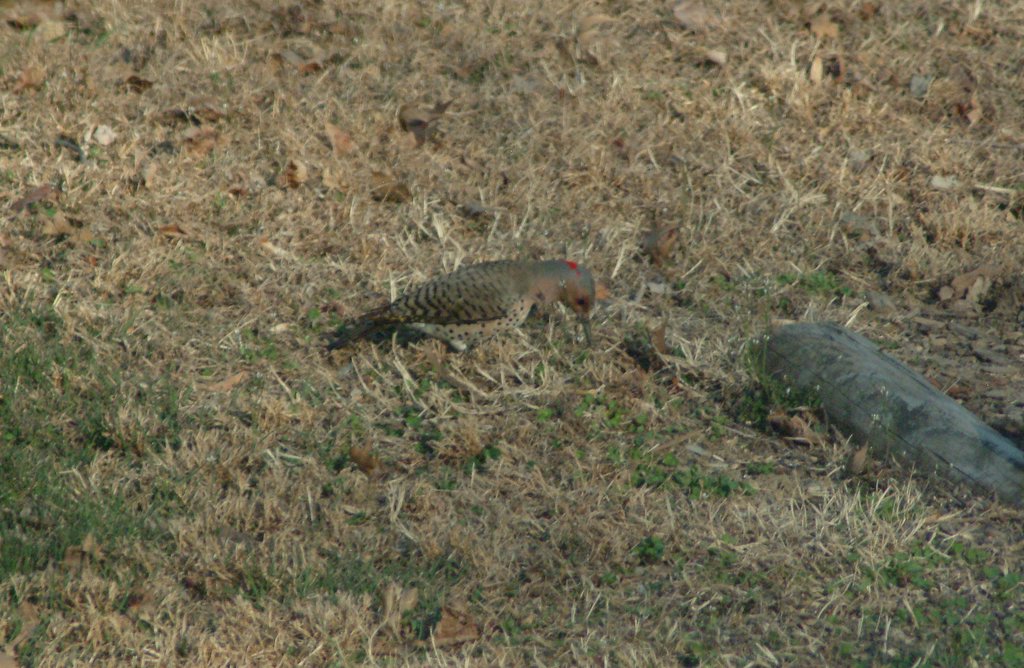
Before the Thanksgiving digressions, I showed photos from visits to the Habitat by a pair of pileated woodpeckers , the many downy woodpeckers, and the red-bellied woodpeckers. That leaves one last woodpecker seen in the Colvin Run Habitat – the Northern Flicker. The northern flickers that appear in the eastern part of North America are the only brown-backed woodpeckers. The flickers are the only woodpeckers in North America that commonly feed on the ground, searching for ants and beetle larvae.
In the first three photos, you can see the flickers on the Habitat lawn. Actually, the arrival of the flickers is a good sign that there are ants and beetle grubs in the lawn, and hence, there is not really much of a lawn.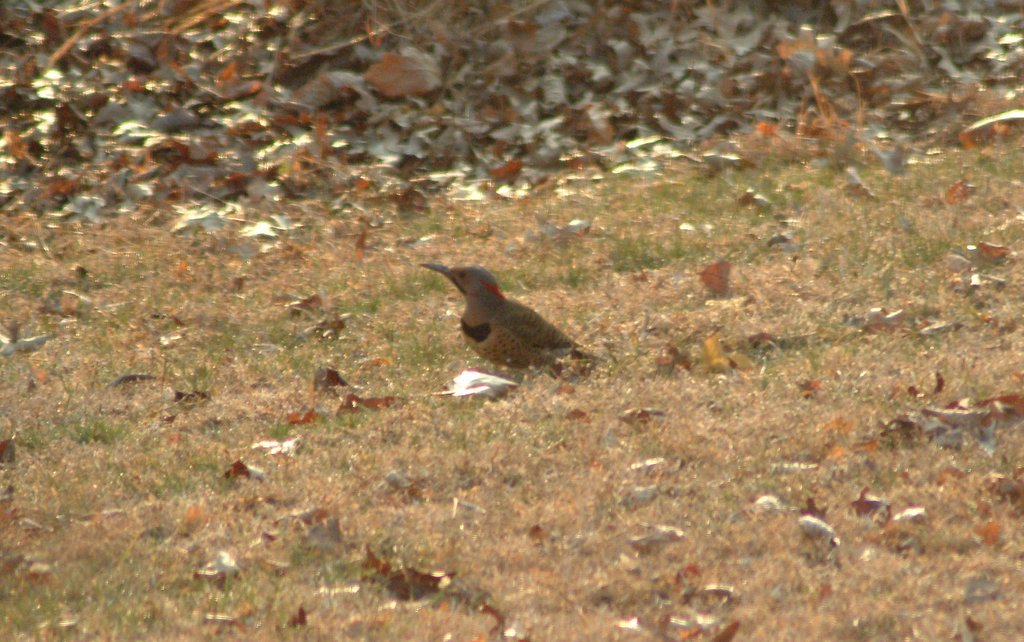 Like many of the woodpeckers, the flicker has a patch of red on its back. However, I think that the distinguishing feature is the black ‘bib’ on its front.
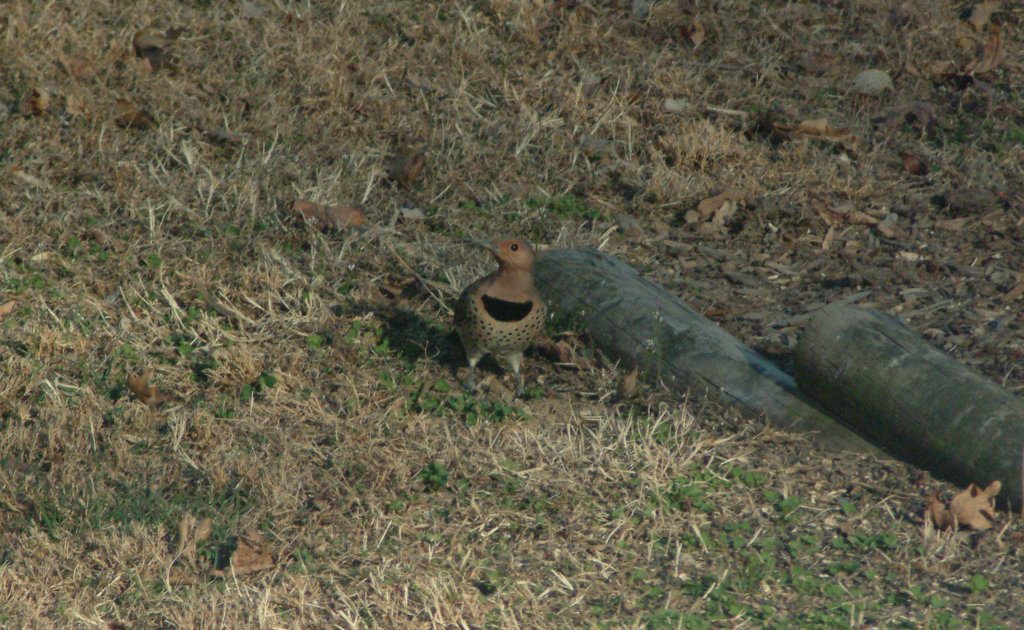 Often seen on the ground with a robin nearby, the flicker will ‘drill’ the ground much as other woodpeckers ‘drill’ a tree trunk.
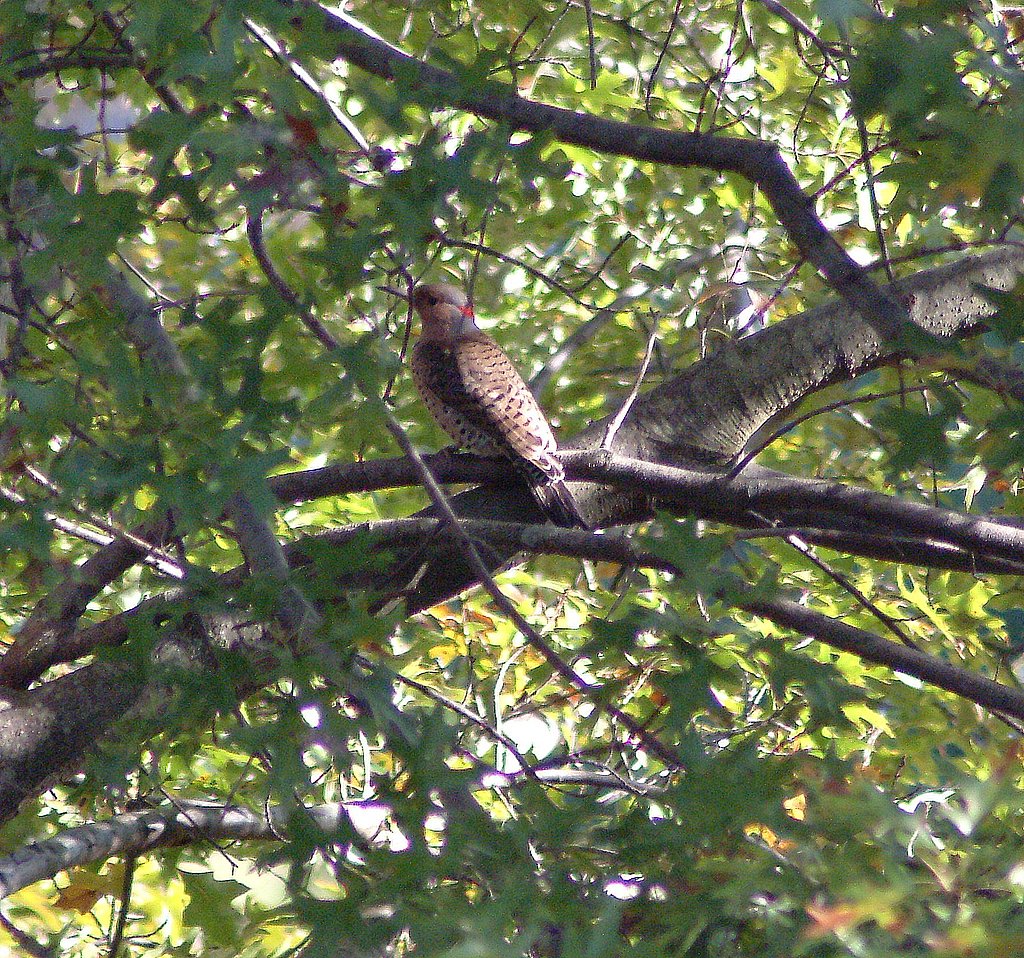
 On some occasions, you will find a flicker perched in a tree.

 American Robins are numerous in the Habitat, but usually from late-March through August. So, I was quite surprised to see a half dozen robins today. Equally unusual was that they were observed in the trees (first two photos), whereas they are mostly found hunting earthworms on the ground. While migrating robins sometimes go no further south than the mid-Atlantic area, they are rare winter visitors to the Habitat.

Another Habitat visitor that is almost always found on the ground is the Northern Flicker, the only North American woodpecker one that you will see on the ground. Unusual to see one in the Habitat trees (third photo). Flickers are frequent Habitat visitors during the spring. This flicker is the first one seen since about June.
The other unusual sighting today was the hawk. And, as before I was on the porch and the camera was upstairs, so I have no photos. Here is what was unusual - this red-tailed hawk was on the ground, specifically at the base of one of the dogwood trees. Not too unusual to find the hawk on the ground. However, he was eye to eye with a squirrel coming down the trunk of the dogwood. The hawk clearly was not enjoying the position of looking up at what otherwise might have been lunch. The squirrel held is ground (or his trunk) and the hawk finally flew away. And, as mentioned earlier in the week, the fox is back (last photo). This morning, he made a run at the birdfeeder - I am never too sure what he is hunting when he makes such runs - equally likely he is after a squirrel or a bird. This time, he caught no breakfast. He reappeared about 15 minutes later and took up his normal observation seat in the bush at the edge of the lawn. He stayed for about an hour - just taking in the sights.


This work is licensed under a Creative Commons Attribution-NonCommercial 3.0 License.