Blizzards of 2010: Signs of the Fox


This spring we have had a fox hinting in the Colvin Run Habitat. We have seen this fox chasing squirrels - one time successfully. We even have squirrel parts to prove his presence. But, no photos - until today. This young fox came on two occasions - separated by about an hour - and feasted on sunflower seeds on the ground under the bird feeder.
 Although his coat is clearly dirty and wet (it has been raining in Northern Virginia for at least three days, this fox appears in good health. He has no signs of mange and he has clear eyes. As the photos show, he and I spend several minutes eye-to-eye (or eye-to-lens). I stayed on the porch hoping not to spook him.
 A quick summary of previous posts about foxes in the Colvin Run Habitat and about mange illness in foxes. There many postings about Red-tailed Foxes visiting the Habitat, but only three postings about foxes infected with mange. I am posting this update to make sure that all information we know is easily found in this blog.
First and foremost, regardless of how cute they are, foxes are wild animals. Kids - talk to your parents. Parents - make sure you use good judgment and appropriate caution.
Fact and Fiction about Foxes with Mange:
>It is very common for individuals to believe that if they see a fox near their homes, looking or acting sick, that it must have rabies. 99% of the time this is not the case.
>The animal most likely is suffering from mange; a debilitating condition that causes severe scratching, open sores and loss of hair. >The good news is that it is easily treatable.
Information to help you understand an animal with mange:
>A fox with mange is very weak from an inability to hunt for food.
>They are tired and suffering from constant itching and burning sensations.
>Because they must eat they will venture close to homes looking for food. Pet food that is left outside is a frequent choice.
>The fox will not attack cats, dogs or children. Even under normal circumstances it is not aggressive. It will react however, if trying to be captured.
>They do not want to take up residence in your area permanently. If treated and allowed to recover they will move on.
However, mange, like many illness, needs to be treated with medication:
>See this site from upstate New York for details
>Mange in foxes is treatable with Ivermectin which is inexpensive and easy to obtain.
I am hoping that the recent anonymous commenter from Great Falls, Viriginia (a community adjacent to the Colvin Run Habitat), will continue to keep us up to date on the progress of treating his foxes.
If you have observations of foxes with mange and especially if you are able to treat mangy foxes with Ivermectin, I hope that you will post a comment and let us know your actual experiences and results.
In the meantime, 9 months have passed since we have observed a fox in the Habitat. But hope springs eternal, and we continue to wait for another blessing of foxes.
 In a great seven day period, the Colvin Run Habitat observed a new bird and welcomed back two long time visitors.
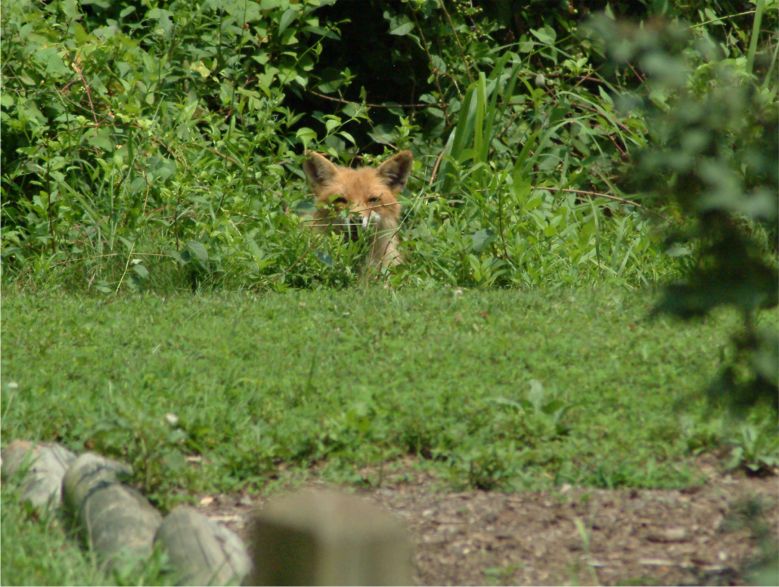
First, the hummingbirds returned last Sunday at the break of dawn (no new photos yet). Second, on Friday morning, a never before seen rose-breasted grosbeak joined the cardinals at the bird feeder (photos to follow in a later post). Third, this morning (Saturday), a red-tailed fox wondered through the Habitat. My wife came yelling into the house, I grabbed the camera, and by sheer luck caught 4 poor quality photos. One of the photos is posted above. Why is it that some of our most interesting wildlife comes when the sky is overcast and stays in the shade?
Regardless, exciting news that we have another fox in residence, hopefully.
amanda in the city asked in a comment last week, 'Whatever happened to the sick fox?' When I last observed the sick fox, I had begun to put food out each night. The food disappeared; whether eaten by the fox or some other animal, I never knew. However unable to make contact with a previously mentioned wildlife recovery group, I had no strategy for treatment other than providing food.
After a few nights, the food was no longer eaten. Given a reading that a fox with mange seldom lives longer than 4 months and that I have not see the fox again, I assume that this fox died.
Since that time, I have found a rescue center in upstate New York offering a treatment strategy. If another fox with mange appears in the Colvin Run Habitat, I will employ the recommended strategy.
In the meantime, we await the arrival of a new fox, or two, or even a family.
The photo in this post is the signature Colvin Run Habitat fox - not the fox observed sick with mange.
Included here are photos never before posted, as well as three that were posted in October 2006. As always you can click on the photos to get an enlarged version.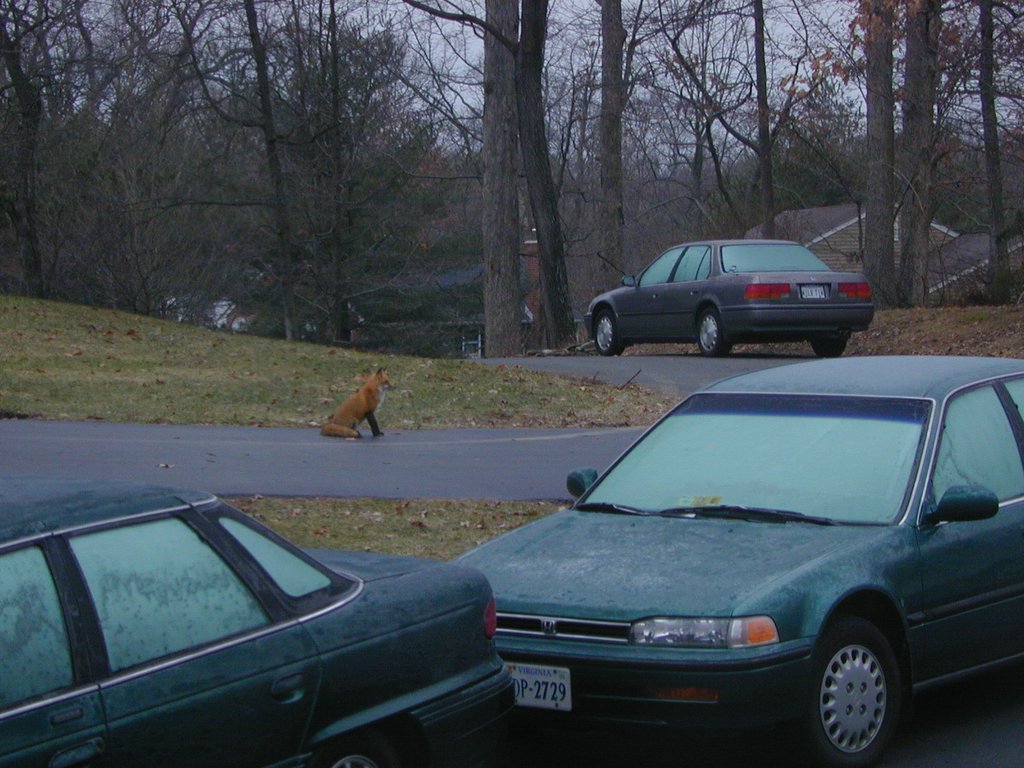 The Colvin Run Habitat's first observed fox visitor (pictured above) occurred on January 5, 2005, when this male brought his red coat and white-tipped tailed up the front drive.
  He promptly took a rest on his rear haunches and looked around as if he owned the place. He stayed for about five minutes. I documented this 2003 visit, as well as an encounter between a different fox and a doe and her fawn.
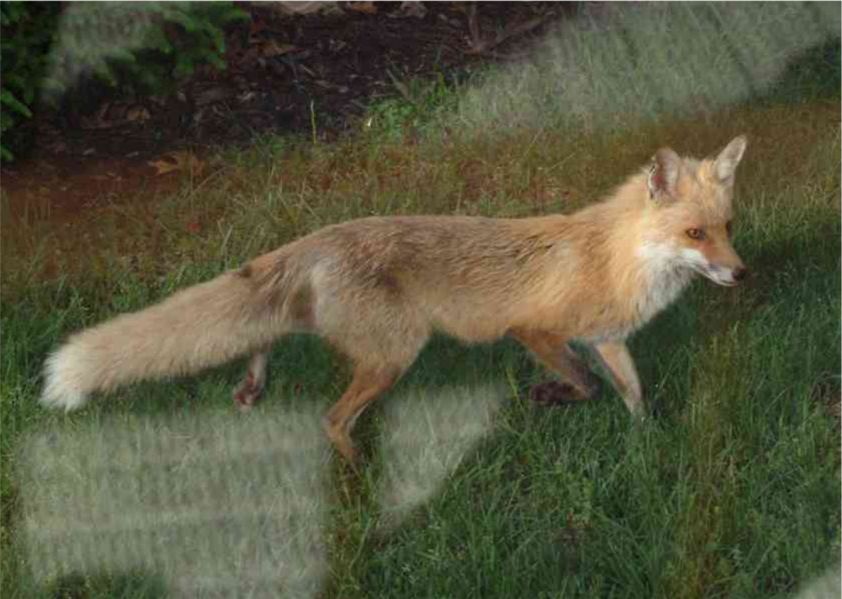 Over the last 20 months, we have had at least 6 foxes visit on multiple occasions the Colvin Run Habitat. Beginning May 2006, and through the winter of 2007, the fox in the second photo was a near daily visitor. During this time, she and her mate would come and spend literally hours sunning themselves in the brush at the edge of the lawn. The fox would come chase squirrels through the yard and even up and through the steps leading up to the porch. These adventures are posted many times (at here and here).
 I first observed her on Sunday morning about 10 AM in the bright sun eating sunflower seeds under the bird feeder.
 The very next morning, this fox returned to the feeder and proceeded to walk through the shrubs and head to the next yard.
 When all of a sudden, the mate came out of the shrubs from a different place. The two then began a playful run across the neighbor's lawn and off into the next woods.
 These photos are the only ones I managed to get of the pair together. I always assumed that one of them was always with the young. As you can see from these photos, in their spring/summer coats, it is difficult to tell them apart.
 I only saw the pair one other time together. One morning in August 2006, I looked out to see the pair bringing two of their young through the shrubs in the Colvin Run Habitat. The kits, then approximately five months old, were nearly as large as the parents. As the kits would run through the shrubs and out of sight of the parents, one of the parents would hop up on the bench in the yard to get a higher view of the wondering kits. The four finally stopped playing and headed off into the rest of the neighborhood.
 Since early spring 2007, two other different foxes have visited separately on multiple occasions. These later two have been the subjects of two recent posts (1 and 2)concerning foxes with mange.
 I am starting this new post, with photos previous posted. If you prefer not to see a seriously ill fox, go no further than these first five photos.
 I am writing this posting for two reasons. First, I think that it is appropriate to show that life for the animals in the Colvin Ron Habitat can be tough.
 Second, I believe that this is an opportunity for wildlife education. Specifically, to discuss a fox infected with mange versus a fox with rabies.
 These photos show a 120-day progression. In early October, this fox appeared healthy. In fact, I commented in a post that he looked healthy. By mid-November, even though he appeared to look (to me) healthy, he was beginning to stop and scratch himself. A sign of possible mange.
 Here are three photos from the last week in January. Clearly, he is ill and in bad shape. I included the last photo to show his face as a comparison with the photos from October and November - this is the same fox. In the last photo, he did not stop and turn around to look at me - rather he stopped to bit at his shoulder.
 After taking these photos, I again turned to the Web seeking an explanation. I would like to thank the National Fox Welfare Society for their photos of foxes with mange.
 I would also like to thank the Wild Bunch Rehabilitation folks for their exaplanation of mange. Please visit their site. In fact, their information is so useful that I am repeating it below. Remember, you should not be approaching animals in the wild. Contact a local wildlife relief agency in you area.
Help! There's a fox outside during the day. What do I do?
Do you observe any of these behaviors?
>It is scratching, chewing or licking its skin.
>It has open sores or wounds.
>It has a bare tail, squinty eyes and/or a crusty film over mouth, eyes and nose.
>It moves slowly and often lies in one place for a long period of time.
>It appears thin, ragged and malnourished.
>It walks very slowly with stiff movements of hind legs.
>It is searching for food in daylight and close to humans and does not seem afraid.
Fact and Fiction about Foxes with Mange:
It is very common for individuals to believe that if they see a fox near their homes, looking or acting sick, that it must have rabies. 99% of the time this is not the case. The animal most likely is suffering from mange; a debilitating condition that causes severe scratching, open sores and loss of hair. The good news is that it is easily treatable.
Information to help you understand an animal with mange
>A fox with mange is very weak from an inability to hunt for food.
>They are tired and suffering from constant itching and burning sensations.
>Because they must eat they will venture close to homes looking for food. Pet food that is left outside is a frequent choice.
>The fox will not attack cats, dogs or children. Even under normal circumstances it is not aggressive. It will react however, if trying to be captured.
>They do not want to take up residence in your area permanently. If treated and allowed to recover they will move on.
What can you do?
>Stay calm and remember you are not in an unsafe situation.
>Call the Wildlife Rescue League at 703-440-0800. You will be put into contact with someone that can give you more information to handle your situation.
>Don’t attempt to capture the animal.
>Provide food and water for the animal - preferably in a safe quiet area.
>If being treated for mange, allow the fox to rest and heal in a place where you can monitor progress.
>Keep information available for neighbors that have questions or concerns.
It was a classic, cold, gray, and damp November morning in the Colvin Run Habitat. The red-tailed fox, who had visited several mornings this week, arrived and promptly laid down in the grass for a nap.  When no squirrels arrived, this young fox became increasingly interested in the mourning doves eating sunflower seeds off of the ground. Finally, the fox made his run, only to have the doves fly away (note the dove in flight in the second photo).
 He paused for a photo and allowed me to confirm his good health.
  Then, still enjoying the slow Saturday morning, sat down to scratch behind his ear.
 Then with undulating movement, he stretched his back and leg muscles before before beginning his departure trot.
 Look who paid a visit to the Colvin Run Habitat this morning. This young fox made his second visit to the Habitat; he first visited on August 30.
 When first observed, this fox was laying on the grass in a open part of the lawn and mulched garden area. He was extremely comfortable; at one point he nearly dozed off.
 At one point, something caught his attention. As the next door neighbor's dog was not out, I am guessing that the fox heard a squirrel. Given his height and the height of the shrubs, I do not belief he saw anything. In response, the fox stood up, then sat on his back legs. He then jogged through the shrubs and bounced up onto a stone bench (see last photo which does not really show the fox's face or the bench). This is not the first fox to perch on this bench to get a view above the shrubs.
  As can be seen from these photos, the fox appears healthy with clear eyes, a full coat and tail, and great color. This is the smallest of the foxes that have ever visited the Habitat. This youngster stayed four minutes, then exited exactly as he did on his last visit.
I took the last month off - for a variety of unintended reasons. But, like the fox pictured here, I am back.


Yesterday was one of those exceptional days in the Colvin Run Habitat.
Here is the report filed by the Number 2 Colvin Run Habitat observer:
>>Fox came out of the bush looked around, definitely not Freddy, younger, white tail and chest. By the time I got camera he had gone down into the brush.
>Fox was observed two times later in the afternoon - coming out of the bush, attempted to grab a squirrel, then into the brush.
>Hawk was also in yard today, landed twice by oak tree, pecked at the ground and than fly away. He was too fast for camera.
Freddy is her name for the signature Habitat fox. 'Bush' refers to the overgrown holly shrub that is behind the water tub and bird feeder - the winter home to many birds. 'Brush' refers the the area of tall grass and wild vines where last year Freddy hung out. Given the her description of the hawk, possibly the active red-shouldered hawk (who previously was photographed on the ground) or possibly the returning Cooper's hawk.  With this news, I spent the better part of an hour just watching hoping to get a photo of the new fox - no luck. But within an hour I did observe a wide range of bird types - the photos show a few. The number of woodpeckers - downy, hairy, red-bellied - easily exceed 30 in the one hour period.
 At sunset, three deer came to through, eating as they went.
  What a day!


This work is licensed under a Creative Commons Attribution-NonCommercial 3.0 License.